I've paid my dues. Starting
back in 1970, I coached and ran the minor league (semi-pro)
Hagerstown Bears for three years. Many of my players were pretty good -
they'd been cut by the (Baltimore) Colts, Eagles, Steelers or Redskins,
and when the World
Football League
started up in 1974, I parlayed my knowledge of how to find players
into a job with the new league. I spent two years in the WFL,
first in 1974 as Player Personnel Director of the Philadelphia
Bell, then in 1975, after a move to the West Coast, as Assistant
GM/PR Director of the Portland Thunder. I did gain a measure of
somewhat indirect fame as
the person who signed Vince Papale, the inspiration for the movie
"Invincible," to his first pro contract. (Yes, he had played two
seasons of professional football in the WFL before being "discovered,"
a fact conveniently left
out of the rags-to-riches tale told in the movie.)
When the WFL went out of business in
mid-season 1975, I stayed in the Northwest and returned to college to
pick up the education credits I needed so I could teach and coach. I
started teaching and coaching in the
fall of 1976 at Gaston, Oregon High, a rural school with fewer than 200
kids in four grades. (Just in case you're wondering if it's too late
for you to get into teaching and coaching, I was 38 years old at the
time.)
Since
then, I've been a head coach at seven different high schools,
large and small, rural, inner city and suburban. I've been an assistant
at five different schools. And I've spent seven summers coaching
in Europe.
In areas other than coaching, I spent the
summer of 1986 as an intern in the athletic department at LSU under AD
Bob Brodhead, my former boss with the Portland Thunder.
For three years, I did color analysis on
Portland State's telecasts.
I've coached overseas, in Denmark and Finland;
the highlights of my seven years in FINNISH FOOTBALL
from 1987-1993 were (1) Winning the Maple Bowl, the National
Championship of the top division, in 1989, and (2) building a
new team totally from scratch and in our second year winning
the 1992 Division II National Championship and the
Division II Coach of the Year award. It was while in Finland that I
first saw Coach Don Markham's Double-Wing in action, and it was while I
was there that I incorporated his "toss" play into the Delaware Wing-T
I
had been running. Using the numbering system and terminology I
had developed, I began
running my version of the Double-Wing.
In 1996 I was named head coach at LaCenter,
Washington, High, a school of about 600 students (9-12) some
20 miles north of Portland, Oregon. At the time I was
hired, the Portland Oregonian called La Center "perhaps the
most forlorn program in the state of Washington." (During the 1980's,
La Center had once lost 39 games in a row.) By my third year,
1998, we made it to 5-4, not a spectacular mark by most standards, but
at La Center, the first winning record in the school's history as
an 11-man program!
In
1997, while at LaCenter, I introduced a direct-snap version of my
Double-Wing offense
which we called the Wildcat - because that was our nickname.
(Not very original.) We ran it in our last two games, and won them
both, one of them a runaway victory over a school two classes larger!
(After
the 1998 season, I wrote an article about it - "Wildcatting With the
Double Wing")
for Coach and Athletic Director magazine.) I found it amusing, to say
the least, when in the 2008 NFL season the Miami Dolphins began running
a direct-snap series which they called, for some reason (maybe the
article?) "The Wildcat." Even more amusing was the number of
people who came out of the woodwork claiming to be he source of the
name.
(I take great pride in the fact that my
successor at La Center, John Lambert, a former student, player and
assistant of mine, has since taken the program to great heights,
including the 2003 state Class 2A Semifinals, and has established
LaCenter as a state small-school power.)
In 1999, I accepted the head coaching job
at Washougal, Washington,
the town adjacent to Camas, where I live. Washougal had won just
two games in the previous two seasons, but when I arrived I found good
kids who told me they were willing to work hard - and sure enough, they
were. Although they had been a passing team, they took a quick liking
to the Double-Wing, and after losing our first two games to strong
opponents, we got it together and ran off seven straight, finishing the
regular season at 7-2, the unbeaten Southwest Washington AA league
champs. I was deeply honored to be voted Coach of the Year by my fellow
coaches. In April of 2000, with some regrets, I chose to resign my
position.
In 2003-2004 I was privileged to work as an
assistant to head coach Tracy Jackson at Madison High School
in Portland, coordinating the offense. (Guess what we ran?). In 2004,
after winning only four games total in the previous four years, Madison
finished the regular season 7-2, its best record in years.
In
July of 2005, when Tracy left to take another job, I elected to stay
behind and replace him at Madison. It was not an on-the-field
success. The timing was bad, we
were very young and inexperienced, and we lost every game. We moved the
ball okay - we just couldn't stop anybody. The kids worked hard and
gave me everything they had and I
love them dearly. They were simply outmanned.
In
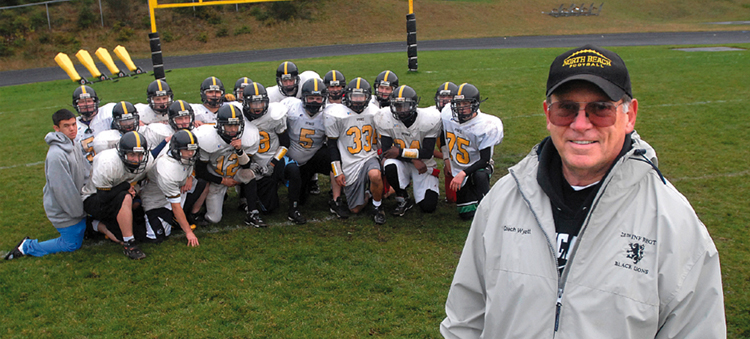
2008, I was attracted to a job at North Beach High School, in the
quaint resort community of Ocean Shores, Washington. My wife and I
rented a neat ocean-front condo for the season, and I was able to
convince some other coaches to join me, including recently-retired Jack
Tourtillotte, veteran Double-Winger from Boothbay, Maine. The upshot of
it was that we were able to take a good group of kids who had been 1-9
in 2007 to a 7-3 finish in 2008. Our three losses were by a total
margin of 11 points.
We rushed for 3670
yards - an average of 367 yards a game . We ranked fifth in the state
in our class in scoring, and outscored opponents
353-172. In a
tribute to our players and coaching staff, I was named Pacific League
Coach of the Year, and I was the subject of a very nice feature in the
Aberdeen Daily World.
In 2011, I returned to North Beach at the
request of new head coach Todd Bridge, to assist him in rebuilding the
program, which had won just three games in the two years since I'd
left. We've worked well together in re-establishing a culture
built on Three R's - Respect, Responsibility and Resilience - and in
building a program based on sound fundamentals. In 2011, with a
lineup of mostly freshman and sophomores, we managed to win three
games, including an upset of the defending state champions, and in 2012
we won four games and a spot - barely - in the state playoffs.
In 2013, expanding our offense to include an
"Open Wing" package, we finished 7-3.
In 2014, we finished
10-1, finally losing in the state quarterfinals after winning ten
straight. Combining my "Open Wing" with the tried-and-true
Double Wing, we outscored our opponents 437-74 and
experienced
the school's first undefeated regular season ever, its first
outright
league championship since 1975, and its first playoff win since
1983. Todd Bridge was voted Pacific League Coach of the Year
and, following our double-overtime win over league power
Raymond,
Seattle Seahawks' Statewide Coach of the Week. North Beach
finished
Number 4 in the final Washington State Class 2B rankings.
In 2015, despite returning just five players on offense and
four on defense, we went undefeated for the second straight year,
winning our second straight league championship and losing in the first
round of the state playoffs. In ten games, we scored 495 points, and
average of 49.5 points a game, and led the state in scoring.
taking
my lumps
If
it's true that you learn more from losing than you do from winning,
then I've learned a lot. In my first job, in Hagerstown, Maryland, we
lost our first seven games in a row, before we finally won. But then,
fortunately, we won our last seven games, and finished 7-7.
In
2005, my team at Madison High in Portland went 0-9. You're not a coach
until you've survived a season like that. I offer no excuses. I knew
things were going to be tough and I didn't have to take the job. But I
did have a chance to work with some really good kids who gave me
everything they had and never quit, and you'll never get me say
anything that
would reflect badly on them.
I also
know what it's like to be out of work. On two occasions - in 1974 and
1975, the World Football League went out of business, leaving me
jobless. In 1975, it stranded me in Portland, Oregon, 3,000 miles from
my home in Maryland, but it turned out to be one of the best things
that's ever happened to me. I found a high school coaching (and
teaching) job and my wife and I were able to raise our four kids in the
beautiful Pacific Northwest. Unfortunately, they all went away to
college and now they're scattered all over the map. If only they'd all
move back...